
Why STEM Programming in Early Childhood Builds Smarter, More Confident Kids
Why STEM in Childcare Matters More Than Ever
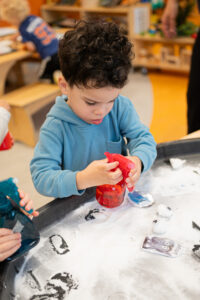
When parents hear the word “STEM,” they often think of high school robotics or university engineering programs. But STEM — Science, Technology, Engineering, and Math — actually begins much earlier.
In fact, early exposure to STEM concepts in preschool and daycare settings plays a powerful role in shaping how children think, solve problems, and approach the world around them.
At Kepler Academy, STEM learning is woven into everyday exploration through our Exploratory Education™ approach. We don’t teach STEM through worksheets — we teach it through curiosity.
What STEM Looks Like in Early Childhood Education
STEM in childcare doesn’t mean memorizing formulas. It looks like:
-
A toddler pouring water between containers and learning about volume
-
Preschoolers building towers and testing balance
-
Children observing how plants grow in different environments
-
Exploring magnets, shadows, and simple machines
These hands-on activities help children naturally develop:
-
Logical reasoning
-
Critical thinking
-
Spatial awareness
-
Cause-and-effect understanding
And most importantly — confidence.
1. STEM Builds Problem-Solving Skills Early
Young children are naturally curious. When they stack blocks and the tower falls, they don’t quit — they rebuild.
STEM programming nurtures that resilience.
Instead of giving children answers, educators ask questions:
-
“Why do you think that happened?”
-
“What could we try differently?”
-
“How can we make it stronger?”
This approach strengthens neural pathways related to executive function — the brain skills responsible for planning, focus, and self-control.
Research consistently shows that early exposure to problem-solving activities improves long-term academic performance in math and science.
2. STEM Encourages Confidence Through Exploration
When children experiment and see their ideas work, something powerful happens: they believe in themselves.
Confidence grows when children:
-
Test hypotheses
-
Make mistakes safely
-
Discover solutions independently
-
Share findings with peers
In a high-quality childcare environment, STEM isn’t about being “right.” It’s about exploration.
At Kepler Academy, educators guide children through open-ended experiments that encourage curiosity instead of perfection.
3. STEM Supports Language Development
Parents often overlook this connection.
STEM activities naturally promote advanced vocabulary:
-
Observe
-
Predict
-
Measure
-
Compare
-
Experiment
-
Discover
When children describe what they see and explain what they think will happen next, they develop stronger communication skills.
Group STEM activities also encourage collaboration and teamwork — building both social and language development.
4. STEM Enhances School Readiness
Children entering kindergarten with early STEM exposure often demonstrate:
-
Stronger number sense
-
Better pattern recognition
-
Improved attention span
-
Higher persistence with challenging tasks
These skills are foundational for academic success — not just in math and science, but across all subjects.
STEM builds how children think, not just what they know.
5. STEM Teaches Real-World Thinking
The world is increasingly driven by innovation and technology. By introducing STEM concepts early, children learn how systems work — from gravity to growth cycles to structural balance.
But even more important, they learn how to think critically.
Instead of memorizing facts, they ask:
-
Why?
-
How?
-
What if?
That mindset prepares them for lifelong learning.
How Kepler Academy Integrates STEM into Daily Learning
Our Exploratory Education™ model incorporates STEM through:
-
Nature-based discovery
-
Hands-on building activities
-
Science-based sensory exploration
-
Collaborative engineering challenges
-
Inquiry-led learning projects
Children aren’t sitting at desks. They’re experimenting, building, testing, observing, and reflecting.
That’s how deep learning happens.
Final Thoughts: It’s Not About Raising Scientists — It’s About Raising Thinkers
STEM programming in early childhood isn’t about pushing children into technical careers.
It’s about developing:
-
Curiosity
-
Resilience
-
Confidence
-
Critical thinking
-
Collaboration
These are life skills.
If you’re looking for a childcare centre in Edmonton that goes beyond supervision and focuses on meaningful development, STEM-based exploratory learning can make a lasting difference.
Book a tour at Kepler Academy today and see how we help children build the skills of tomorrow — today.

Why Nutrition Is Critical in the Early Years
The first five years of a child’s life are a period of rapid brain development.
In fact,…

Hello Kepler Families!
We are the team at Summerside Children’s and Sport Physiotherapy, and we are so excited to meet…