Yes, You Can Set Limits on Treats and Still Raise a Child With a Positive Relationship With Food

By Megan Wallace, RD | Pediatric & Family Nutrition
Read more about Megan Wallace on our Daily Nutrition page.
There has been a lot of conversation over the last few years about how we handle sweet foods, snack foods and “treat” foods with children. A lot of that conversation has been really positive.
Ultimately, what has come out of conversation are thoughts like:
- We’re moving away from labelling foods as “good” or “bad.”
- We’re trying not to use dessert as a reward.
- We want our kids to grow up feeling comfortable around cookies, candy, and chips instead of feeling guilty for eating them or believing they need to sneak them.
But somewhere along the way, I think an important part of the conversation has gotten lost:
Supporting a positive relationship with food does not mean we can never say no.
We’ve moved away from being overly restrictive, which can be a good thing, but sometimes it feels like we’ve swung so far in the other direction that parents are afraid to set any limits at all.
Your child can have a positive relationship with food and you can tell them they cannot have a fourth package of fruit snacks.
Those two things can be true at the same time.
“Not right now” is different from “you can’t have that”
One of the biggest worries I hear from parents is: If I limit it, won’t they just want it more? The answer is more nuanced than a simple yes or no.
Research examining restrictive feeding practices and children’s eating behaviours suggests that highly controlling approaches to food can sometimes have unintended effects. At the same time, the research is mixed, particularly when we look at children’s actual dietary intake, and researchers define and measure “restriction” in different ways.¹
And that distinction is important.
Restriction is not necessarily the same thing as structure.
If a child rarely gets to have a certain food, hears that it is “bad for them,” or feels ashamed for wanting it, that food can take on a lot of emotional weight.
But providing a predictable boundary can look very different.
Let’s say your child has already had some fruit snacks and immediately asks for another package.
You might say:
“I hear you. You really want more fruit snacks. We’re not having another package right now, but we can have some with lunch tomorrow.”
- You’ve acknowledged their desire.
- You’ve set a clear boundary.
- And you’ve reassured them that they will have another opportunity to enjoy that food.
You aren’t saying, “Those are bad for you.” You aren’t saying, “You’ve had too much sugar.”
You’re simply saying: not right now.
Our children are allowed to want more. And we are allowed to say no.
Regular exposure doesn’t mean unlimited access.
Children benefit from opportunities to experience a wide variety of foods, including sweet foods and snack foods, without shame or moral labels.
But regular exposure doesn’t have to mean unlimited access.
In fact, Health Canada’s current guidance around children’s and adults’ roles in feeding draws on the Satter Division of Responsibility: adults determine what, when and where food is offered, while children determine whether and how much they eat from what has been provided.²
The American Academy of Pediatrics similarly recommends regularly scheduled meals and snacks while allowing children to determine what and how much they eat from the foods parents provide.³
In other words, responsive feeding isn’t the same thing as permissive feeding.
Parents still get to provide structure.
Maybe your family includes something sweet with lunch. Maybe you sometimes have dessert with dinner. Maybe your child gets to choose a packaged snack for their school lunch.
And there will also be times when your child asks for something and the answer is no.
You might say:
“We had a Wagon Wheel with our lunch today. How about we have some fruit after supper?”
Or:
“We’re not having a treat right now. We’ll have one with dinner tonight.”
There isn’t a magic number of times children need to be offered sweets or treat foods to develop a positive relationship with them.
Instead, I encourage families to think about creating predictable opportunities for these foods without making them forbidden, emotionally charged or associated with guilt.
So, what about Halloween?
For children ages 1-5, Halloween is a great opportunity to practice the balance between food enjoyment and parental boundaries – but our approach should also reflect a child’s age and developmental stage.
For our littlest eaters, particularly those under age 2, we don’t need to intentionally introduce candy simply because it’s Halloween. Health Canada recommends offering young children nutritious foods with little to no free or added sugars, while they’re learning about food and developing their food preferences.⁴
As children get older, Halloween can include opportunities to explore and enjoy candy without making it feel forbidden or overly exciting. Let them look through their treats, choose some favourites and enjoy the experience. Then, once Halloween is over, simply return to your family’s regular meal and snack routine.
That might sound like:
“You really want some Halloween candy! Let’s choose one to have with our snack.”
Or:
“We’re all done with candy for now. We’ll have some more tomorrow.”
A Quick Halloween Safety Note
For children under 4, not every Halloween treat is developmentally safe, regardless of our approach to food freedom.
Health Canada identifies several choking hazards for children younger than four, including hard candies, gum, popcorn, marshmallows, whole nuts and seeds.⁴
So yes, you can remove unsafe candy from your young child’s Halloween bag. That’s not a food restriction. That’s keeping your child safe.
Boundaries Can Still Feel Kind
Your toddler or preschooler may still be upset when you say no. That’s okay.
We can acknowledge what they want without changing the boundary:
“I know you really want another one. We’re all done for now, and we’ll have some again tomorrow.”
We don’t need to tell them candy is “bad,” that they’ve had “too much sugar,” or that they need to earn it by eating something healthier first. Keep the boundary simple, predictable and neutral.
There isn’t a magic number of treats that creates a positive relationship with food. Instead, we’re looking at the bigger picture: age-appropriate exposure, safe foods, predictable opportunities, no shame – and parents who are still comfortable parenting.
Food freedom and loving boundaries are not opposites. Our kids have room for both.
Recipe of the Month:
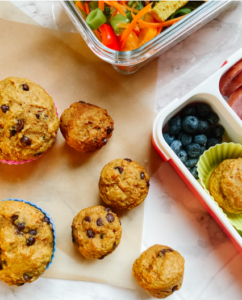
Pumpkin Carrot Chocolate Chip Muffins
They’re soft, lightly spiced and just sweet enough, with mini chocolate chips making them especially kid-friendly. I love recipes like this for busy mornings, lunch boxes or after-school snacks because they give you a little more staying power than your average bakery-style muffin without trying to turn a muffin into something it isn’t.
Makes 12 muffins
Ingredients
- 1¼ cups all-purpose flour
- ½ cup whole wheat flour
- 2 tsp pumpkin pie spice
- 1½ tsp baking powder
- 1 tsp baking soda
- ½ tsp salt
- 1 cup pure canned pumpkin (not pumpkin pie filling)
- ½ cup plain low-fat yogurt
- ½ cup pure maple syrup
- ¼ cup butter, melted
- 1 egg
- 1 tsp vanilla
- 1 cup finely grated carrots
- ½ cup mini semi-sweet chocolate chips
Directions
- Heat your oven to 375°F and lightly grease a 12-cup muffin tin.
- In a large mixing bowl, stir together the all-purpose flour, wheat bran or whole wheat flour, pumpkin pie spice, baking powder, baking soda and salt.
- In another bowl, whisk the pumpkin, yogurt, maple syrup or honey, melted butter, egg and vanilla until well combined.
- Fold the grated carrots, chocolate chips and nuts (if using) into the pumpkin mixture.
- Pour the wet mixture into the dry ingredients. Gently stir until everything is just combined. A few streaks or small lumps are completely fine — overmixing can make your muffins more dense.
- Spoon the batter evenly into the prepared muffin cups.
- Bake for approximately 20–22 minutes, or until the tops spring back lightly and a toothpick inserted into the centre comes out clean.
- Let them cool for a few minutes in the muffin pan before transferring to a cooling rack.
Megan’s Tip
Pair one of these muffins with a protein-rich food: think Greek yogurt, a glass of milk, cheese, eggs or nut/seed butter, to turn it into a more satisfying breakfast or snack.
They also freeze beautifully. Pop extras into the freezer and pull them out as needed for school lunches or those mornings when everyone needs to get out the door five minutes ago.
Recipe credit: Adapted from a recipe in the Looneyspoons cookbook by Janet and Greta Podleski. Instructions and accompanying content have been rewritten and adapted by Megan Wallace, RD.
References
- American Academy of Pediatrics. (2021, July 8). Preschooler food and feeding. American Academy of Pediatrics
- Health Canada. (n.d.). Teaching Canada’s food guide: Children’s and adults’ roles around food and eating. Government of Canada. Retrieved October 1, 2026, from Canada’s Food Guide
- Health Canada, Canadian Paediatric Society, Dietitians of Canada, & Breastfeeding Committee for Canada. (2014). Nutrition for healthy term infants: Recommendations from six to 24 months. Government of Canada. Government of Canada
- Say, A., de la Piedad Garcia, X., & Mallan, K. M. (2023). The correlation between different operationalisations of parental restrictive feeding practices and children’s eating behaviours: Systematic review and meta-analyses. Appetite, 180, 106320. DOI record

By Megan Wallace, RD | Pediatric & Family Nutrition
Read more about Megan Wallace on our Daily Nutrition page.
If mornings in your…
By Megan Wallace, RD | Pediatric & Family Nutrition
Read more about Megan Wallace on our Daily Nutrition page.
There is an…